


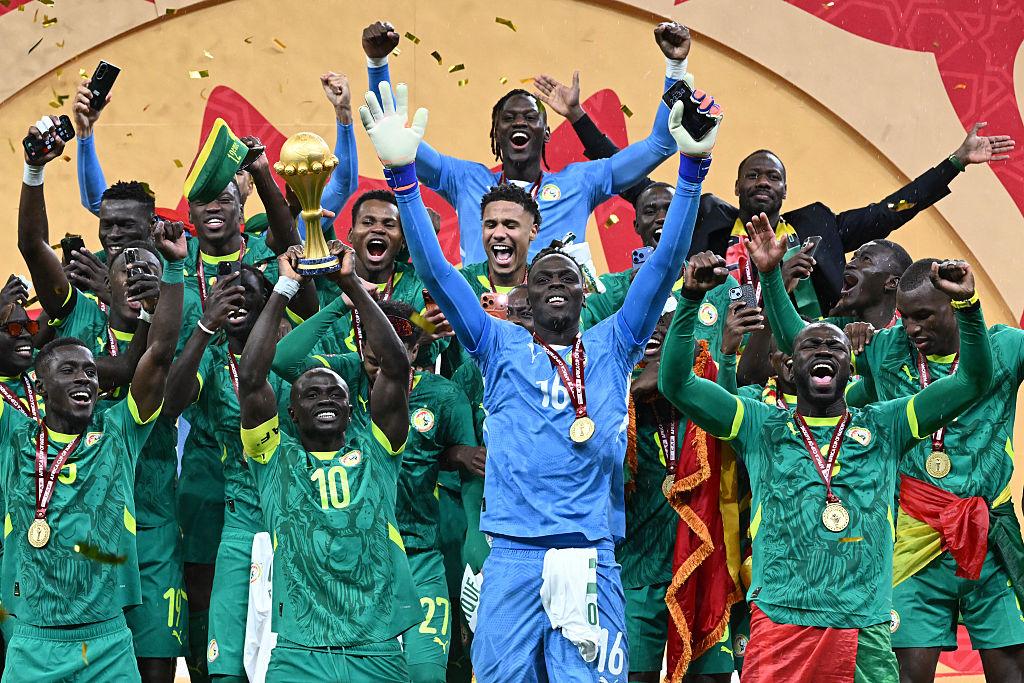
Senegal have officially been reinstated as the 2025 Africa Cup of Nations champions after the Court of Arbitration for Sport (CAS) overturned the Confederation of African Football’s (CAF) controversial decision to strip the country of its title and award it to Morocco.
In a landmark ruling delivered on Tuesday, 24 November 2026, CAS upheld the appeal filed by the Senegalese Football Federation (FSF), setting aside the CAF Appeal Board’s decision and confirming the original 1–0 victory achieved by Senegal in January’s final in Rabat.
The unanimous decision brings an extraordinary legal battle to an end and restores Senegal’s place at the summit of African international football.
For the Teranga Lions, it is a remarkable moment of vindication after months of uncertainty surrounding a championship they had originally won on the pitch.
CAS overturns CAF’s controversial decision
The dispute dates back to the AFCON 2025 final played on 18 January 2026 between Senegal and tournament hosts Morocco at Prince Moulay Abdellah Stadium in Rabat.
Senegal had secured a 1–0 victory after extra time through a spectacular strike from Pape Gueye, seemingly confirming their second continental championship.
However, the final became one of the most controversial matches in recent African football history following a late penalty awarded to Morocco.
With the match still goalless during second-half stoppage time, referee Jean-Jacques Ndala awarded Morocco a penalty following a VAR review of a challenge involving Brahim Díaz.
Senegal’s players and coaching staff strongly protested the decision, with the team temporarily leaving the pitch for approximately 14 minutes.
Play eventually resumed, and Morocco’s Brahim Díaz missed the penalty. The match proceeded into extra time, where Pape Gueye scored the decisive goal that initially handed Senegal the championship.
The controversy did not end with the final whistle.
In March 2026, CAF’s Appeal Board overturned the result, ruling that Senegal had forfeited the match by leaving the field and recording a 3–0 victory for Morocco.
The decision was met with strong opposition from Senegal, whose football federation subsequently appealed to CAS.
Why CAS ruled in Senegal’s favour
At the centre of the legal dispute was whether the referee’s decision to resume the match after Senegal’s temporary withdrawal could be challenged through disciplinary proceedings.
Senegal argued that the referee had the authority to decide whether play should resume and that his decision fell under football’s established ‘field of play’ doctrine.
Morocco, on the other hand, maintained that Senegal had breached Articles 82 and 84 of the AFCON regulations by temporarily leaving the pitch and that the match should have been declared forfeited.
After considering the arguments presented by Senegal, Morocco and CAF, the three-member CAS panel ruled that the referee’s decision to resume or permanently stop the match fell within his authority.
The panel noted that when play restarted, both teams had returned to the field and expressed their willingness to continue.
Consequently, the referee’s decision was protected by the field of play doctrine and could not be overturned on the grounds advanced in the case.
CAS further determined that Articles 82 and 84 of the AFCON regulations applied to situations where a match was permanently abandoned by the referee, rather than one in which play resumed and the contest produced a sporting result.
The panel therefore concluded that the referee had not committed an error of law.
With that reasoning, CAS unanimously upheld Senegal’s appeal and restored the original result.
Morocco lose the title they were awarded
The ruling is a significant setback for Morocco, who had been officially recognised as AFCON champions following CAF’s decision in March.
The Royal Moroccan Football Federation had defended CAF’s ruling during the proceedings, arguing that Senegal’s temporary withdrawal from the pitch constituted a violation of tournament regulations.
However, the CAS decision now removes the 3–0 administrative victory previously awarded to Morocco.
Senegal’s original 1–0 victory is consequently restored, confirming the Teranga Lions as the rightful winners of the tournament.
The decision also brings an end to months of uncertainty for supporters in both countries, although the controversy surrounding the final is likely to remain one of the defining moments in African football governance.
Importantly, CAS noted that separate disciplinary sanctions previously imposed on Senegal’s football federation, coach Pape Thiaw and players Iliman Ndiaye and Ismaila Sarr remained part of the separate disciplinary proceedings. The restoration of the match result does not automatically erase those sanctions.
A major victory for Senegalese football
For Senegal, the ruling represents much more than the restoration of a trophy.
The country had already celebrated its victory in January before being stripped of the title through CAF’s administrative decision two months later.
The prolonged dispute placed the national federation, players and supporters in an uncomfortable position, with the legitimacy of their championship constantly questioned.
Tuesday’s verdict finally provides clarity.
Senegal can now officially celebrate their second Africa Cup of Nations title, adding to their first triumph in 2021.
The decision also strengthens the importance of established sporting principles, particularly the authority of match officials to make decisions concerning the continuation or abandonment of matches.
What this means for African football
Beyond Senegal and Morocco, the ruling has important implications for football administration across the continent.
CAF now faces renewed scrutiny over its disciplinary and appeals procedures, particularly regarding how tournament regulations are interpreted and applied during high-pressure competitions.
For national federations, the case reinforces the importance of clear regulations, transparent decision-making and respect for the authority of match officials.
It also raises important questions about how African football can improve confidence in its governing institutions and ensure that major competitions are decided fairly.
Freekick442 Verdict
Senegal have won their battle both on the pitch and in the courtroom.
While the events surrounding the January final will continue to generate debate, CAS has delivered a unanimous decision that restores the original sporting result.
For the Teranga Lions, the celebrations can begin again. The trophy belongs to Senegal, and African football has witnessed one of the most extraordinary championship disputes in its history.
Senegal are once again the champions of Africa.